
EVIDENCE-BASED APPROACHES · SCHEMA THERAPY
About Schema Therapy
A deeply integrative, evidence-based approach for changing long-standing emotional & behavioural patterns.
Schema Therapy helps you make sense of your past, understand your reactions and feelings in the present, and pave the way toward a more values-driven future. It is my primary modality for individual work — particularly where difficulties have been present for a long time.

ABOUT MENTAL HEALTH SUPPORT
Therapeutic approaches that I draw on during therapy
No single therapy fits every person or every problem. I'll suggest, talk through, and adjust based on what's most useful — these are the frameworks I lean on most.
MY PRIMARY MODALITY
Why Schema Therapy is my Primary Modality
Schema Therapy offers a well-researched, integrative framework that helps make sense of complex emotional and relational patterns that are shaped by adverse early experiences, ongoing stress, and trauma. It provides both structure and flexibility, allowing therapy to be tailored to the individual while remaining grounded in evidence-based practice. This approach integrates well with Cognitive Behavioural Therapy, Exposure and Response Prevention, and EMDR.
WHY IT HELPS
Why I find Schema Therapy so helpful for my clients
Schema Therapy offers a compassionate, structured way to understand why certain emotional patterns and relationship difficulties keep repeating — especially helpful for people who have experienced long-standing stress, trauma, or complex relational histories. Rather than focusing only on symptoms and thoughts, it has techniques that facilitate deeper emotional processing. Research shows these approaches help clients make sense of past experiences, build healthier coping patterns, and move toward meaningful, lasting change.
WHO IT SUITS
Who Schema Therapy can be helpful for
People who feel stuck in recurring behavioural patterns or emotional reactivity, despite insight or previous therapy. It can help with chronic anxiety or low mood, relationship difficulties, effects of childhood or relational trauma, faith-related harm, institutional betrayal, or long-standing self-criticism and shame. Also well-suited to clients who want to understand themselves more deeply, strengthen emotional regulation, and develop healthier ways of relating to themselves and others over time.
Key Components of Schema Therapy
HOW THE WORK UNFOLDS
An approach that addresses long-standing emotional patterns to support meaningful, lasting change. These four pieces interleave across treatment rather than running in strict sequence.
Identify Early Maladaptive Schemas & Modes
This involves identifying long-standing emotional patterns and moment-to-moment coping responses that shape how you experience yourself, others, and relationships, particularly under stress.
Engage in Experiential Techniques
Through experiential techniques such as imagery and chair work, we access the emotions and memories connected to longstanding patterns. This deeper work helps identify the unmet needs that lie beneath complex feelings and experiences, creating space for meaningful change.
Reality Testing and Cognitive Restructuring
This step focuses on examining and gently challenging schema-driven beliefs, helping develop more balanced, compassionate, and realistic ways of understanding yourself and your experiences.
Limited Reparenting and Building Healthier Patterns
Through a supportive therapeutic relationship and practical strategies, unmet emotional needs are addressed while new, healthier ways of relating, coping, and setting boundaries are developed over time.
A REFERENCE
Common Early Maladaptive Schemas
As identified in the research of Jeffrey Young
Disconnection & Rejection
Abandonment
Fear that people will leave or can’t be trusted to stay emotionally present.
Mistrust / Abuse
Expecting others to hurt, abuse, or take advantage of you.
Emotional Deprivation
A sense that your emotional needs won’t be met by others.
Defectiveness / Shame
Feeling flawed, not good enough, or unworthy of love.
Social Isolation / Alienation
Feeling different from others or like you don’t belong.
Impaired Autonomy & Performance
Dependence / Incompetence
Feeling incapable of handling daily responsibilities alone.
Vulnerability to Harm or Illness
Fear that catastrophe (illness, accidents, etc.) is about to happen.
Enmeshment / Undeveloped Self
Feeling too emotionally fused with others or unsure of who you are.
Failure
Belief that you will fail or are fundamentally inadequate.
Over-vigilance & Inhibition
Negativity / Pessimism
Focusing on the negative and expecting the worst.
Emotional Inhibition
Suppressing emotions to avoid disapproval or upsetting others.
Unrelenting Standards / Hypercriticalness
Feeling you must meet high standards to avoid criticism.
Punitiveness
Believing people should be harshly punished (including yourself) for mistakes.
Disconnection & Rejection
Abandonment
Fear that people will leave or can’t be trusted to stay emotionally present.
Mistrust / Abuse
Expecting others to hurt, abuse, or take advantage of you.
Emotional Deprivation
A sense that your emotional needs won’t be met by others.
Defectiveness / Shame
Feeling flawed, not good enough, or unworthy of love.
Social Isolation / Alienation
Feeling different from others or like you don’t belong.
Impaired Autonomy & Performance
Dependence / Incompetence
Feeling incapable of handling daily responsibilities alone.
Vulnerability to Harm or Illness
Fear that catastrophe (illness, accidents, etc.) is about to happen.
Enmeshment / Undeveloped Self
Feeling too emotionally fused with others or unsure of who you are.
Failure
Belief that you will fail or are fundamentally inadequate.
COPING MODES
Common Schema Therapy Modes
In Schema Therapy, modes describe the emotional states or “parts of the self” that become active when core emotional needs are not being met. These modes can appear suddenly — especially under stress, in close relationships where we feel hurt or disappointed, or when long-standing patterns (schemas) are triggered. Most people shift between different modes throughout the day, sometimes rapidly, particularly when exposed to a trigger. This rapid shifting is often referred to as a mode cycle.
Understanding modes helps explain why reactions can feel intense, sudden, or “out of character.” Rather than viewing these responses as personal failings, Schema Therapy understands them as meaningful patterns that once served a protective purpose. By thoughtfully exploring your individual modes, therapy helps reduce the impact of unhelpful coping or overly critical states, and supports the development of a strong, compassionate Healthy Adult mode.
MY PRIMARY MODALITY
Ways of managing or avoiding emotional pain
Coping modes often emerge automatically and can be difficult to recognise in the moment. While they may have been adaptive at an earlier time, they can limit emotional closeness, flexibility, and wellbeing over time.
Detached Protector
Emotional withdrawal, numbing, distraction, or shutting down to avoid overwhelm or emotional pain. Can create distance in relationships and reduce access to feelings and needs.
Compliant Surrenderer
Giving in, people-pleasing, or prioritising others’ needs to avoid conflict, rejection, or disapproval. Over time, this can lead to resentment, exhaustion, or a loss of self.
Overcompensator
Attempts to counter vulnerability through control, perfectionism, dominance, achievement, or self-reliance — often masking underlying fear, shame, or insecurity.
CRITICAL & DEMANDING MODES
Internalised rules and judgments
These modes reflect rules and judgments developed in response to early experiences of pressure, criticism, or conditional acceptance. Often intended to prevent failure or rejection, they can become harsh, inflexible, and emotionally costly over time.
Punitive Critic
An inner voice that attacks, shames, or blames, often reinforcing feelings of worthlessness or failure.
Demanding Critic
Internal pressure to meet high standards, be productive, or “do better,” often at the expense of rest, emotional needs, or self-care.
The Inner Gaslighter
The Inner Gaslighter is an internalised voice that dismisses and denies your own experiences, telling you you're overreacting, imagining things, or being too sensitive. It turns the dynamics of external gaslighting inward, so legitimate emotions and perceptions get minimised or doubted before they're even fully felt.
VULNERABLE MODES
Emotional needs and reactions
These modes reflect emotional needs, reactions, and developmental responses — and often emerge when a person feels criticised, rejected, unsafe, or treated unfairly.
Vulnerable Child
Feelings such as sadness, fear, shame, loneliness, or helplessness. Often emerges when a person feels criticised, rejected, unsafe, or emotionally exposed.
Angry or Distressed Child
Anger, frustration, or distress when needs feel ignored, boundaries are crossed, or a person feels treated unfairly.
Entitled Child
A state where emotional needs feel urgent and non-negotiable, leading to strong expectations that others should meet those needs immediately.
FORENSIC MODES
Situational survival states
Forensic modes may emerge in situations involving threat, power, conflict, or survival. These are situational states rather than fixed traits and can occur in people with no involvement in forensic or legal systems. Schema Therapy approaches them with curiosity and containment.
Bully & Attack
Responding to perceived threat or vulnerability with aggression, intimidation, or attempts to dominate in order to regain a sense of control.
Predator
Emotional detachment combined with goal-focused behaviour, where empathy is temporarily switched off to achieve an outcome or avoid perceived danger.
Conning & Manipulative
Using charm, deception, or manipulation to protect oneself, maintain control, or avoid consequences.
Paranoid / Suspicious
Heightened mistrust, hypervigilance, or readiness to perceive threat, often shaped by past experiences of betrayal, danger, or injustice.
THE AIM OF SCHEMA THERAPY
Healthy Adult Mode — strengthening the part that integrates the other parts of self to promote emotional balance, insight and resilience
The Healthy Adult represents emotional balance, insight, and psychological resilience — the part of the self that can hold difficult feelings, reflect rather than react, and respond in ways aligned with values and long-term wellbeing. A central aim of Schema Therapy is to strengthen and stabilise the Healthy Adult, so it becomes more accessible in everyday life and especially during moments of stress or relational difficulty.
— Recognise and soothe vulnerable parts
— Set boundaries with critical or coping modes
— Tolerate emotional discomfort without acting impulsively
— Balance needs, responsibilities, and self-care
— Respond to others with empathy, firmness, and flexibility
— Respond to self and others with compassion
A SCHEMA THERAPY CASE EXAMPLE
Meet “Sam”
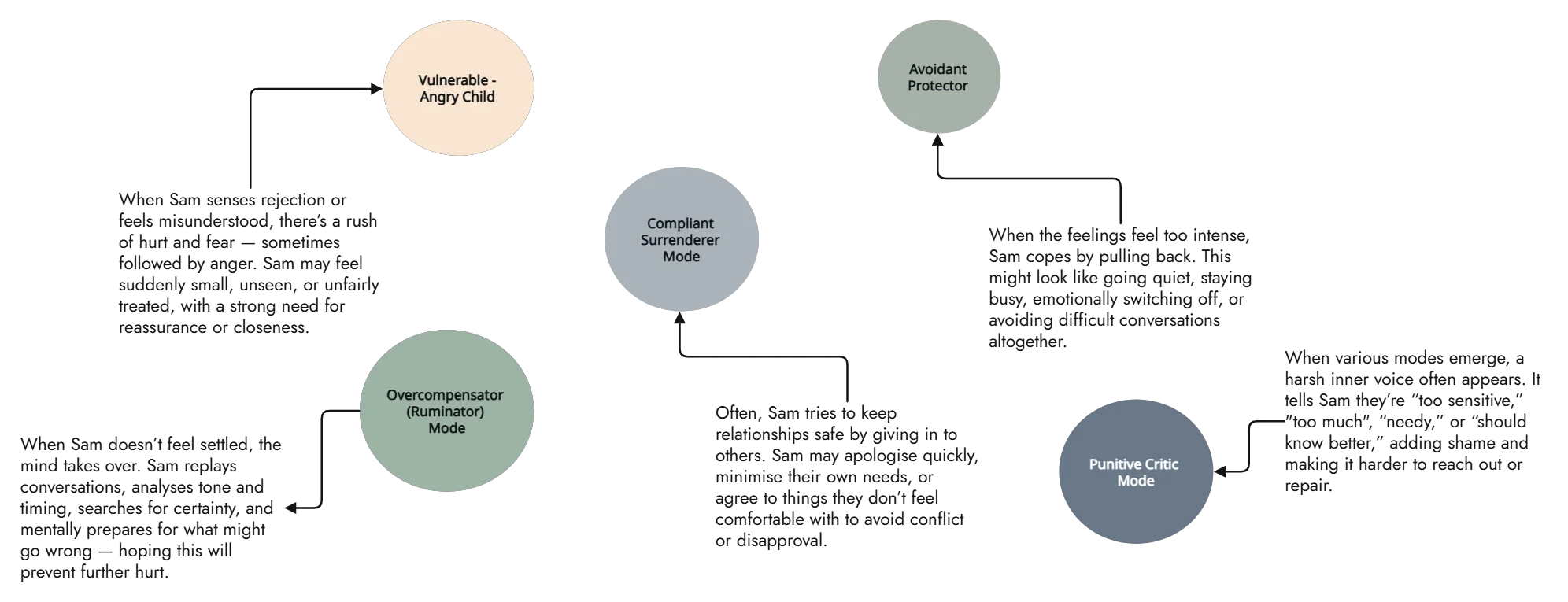
(Note: this is not a real client.) Sam is someone who values close relationships, but finds that under stress — especially when feeling hurt, rejected, or misunderstood — different emotional “modes” can take over. At times, Sam may feel vulnerable or angry; at other times Sam copes by shutting down, overthinking, giving in, or turning inward with harsh self-criticism.
01
Sam’s Common Schema-Driven Modes
Sam moves between different emotional states, or modes, depending on stress and relationship triggers. At different times, one mode can take over while others move into the background.
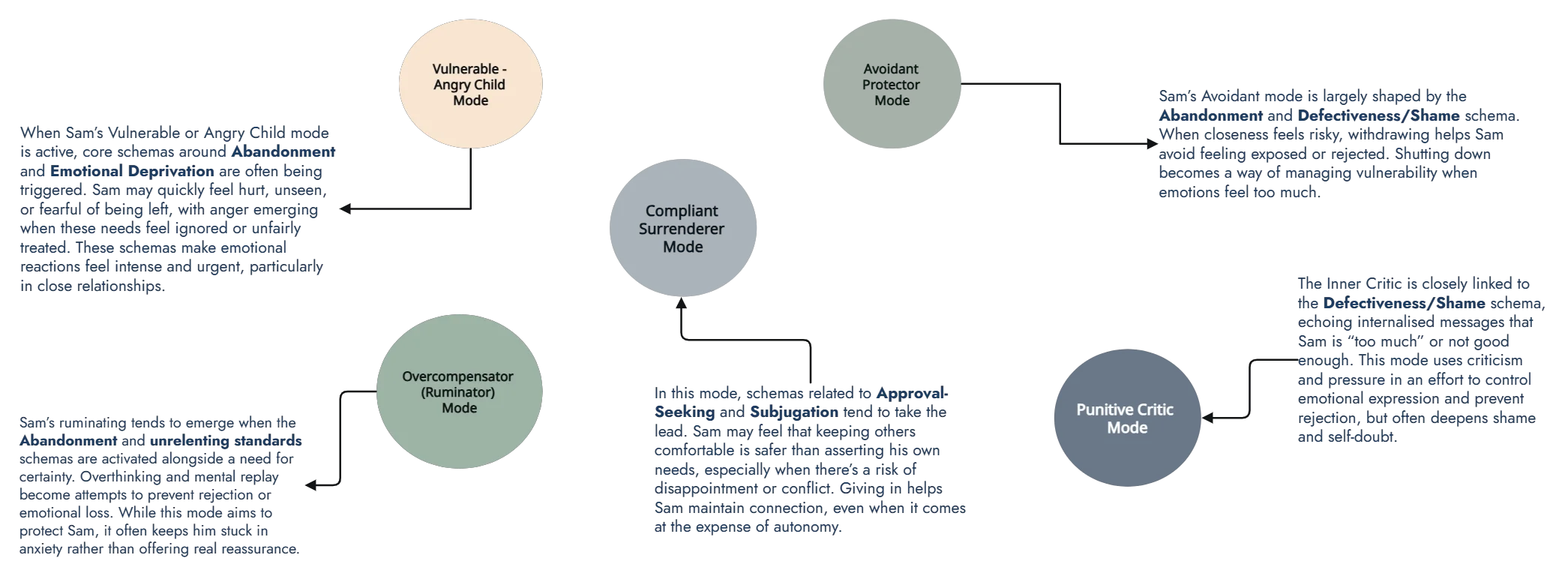
Underlying schemas influencing Sam’s modes
Schemas are deeply held beliefs linked to emotional and bodily responses, and they play a key role in shaping Sam’s reactions. When particular schemas are triggered, they tend to show up through different modes — representing Sam’s attempts to protect himself from the vulnerable feelings that arise. In therapy, Sam will begin to understand these beliefs, and where they emerged from.
02
03
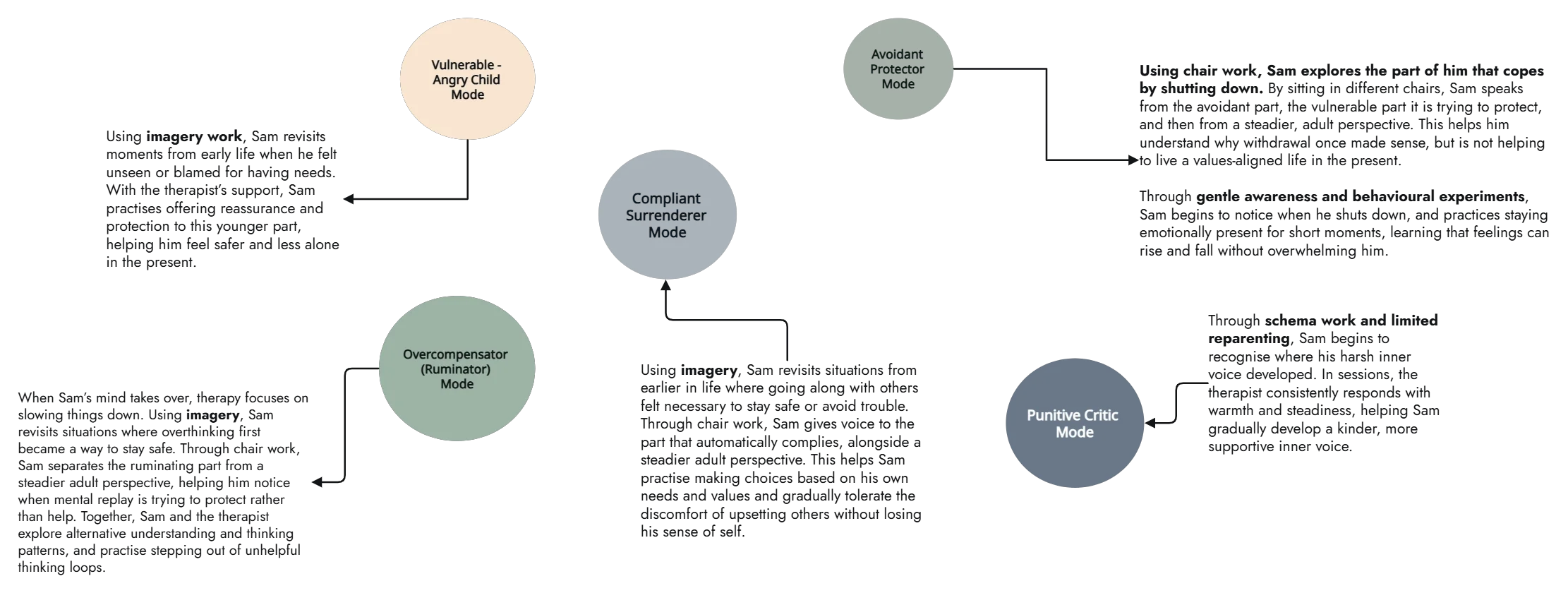
How Schema Therapy helps shift unhelpful modes
Imagery work uses guided imagination to revisit emotionally significant experiences, reducing the intensity of present-day triggers and developing new, more supportive responses. Chair work uses different seats to explore and respond to different parts of the self, making patterns easier to notice and change. Limited reparenting involves the therapist offering a consistent, supportive relationship that helps Sam build self-compassion and a stronger inner voice. Mode maps and cognitive & behavioural activities allow Sam to recognise patterns, test old beliefs, and practise responding in ways that better support his values and relationships.
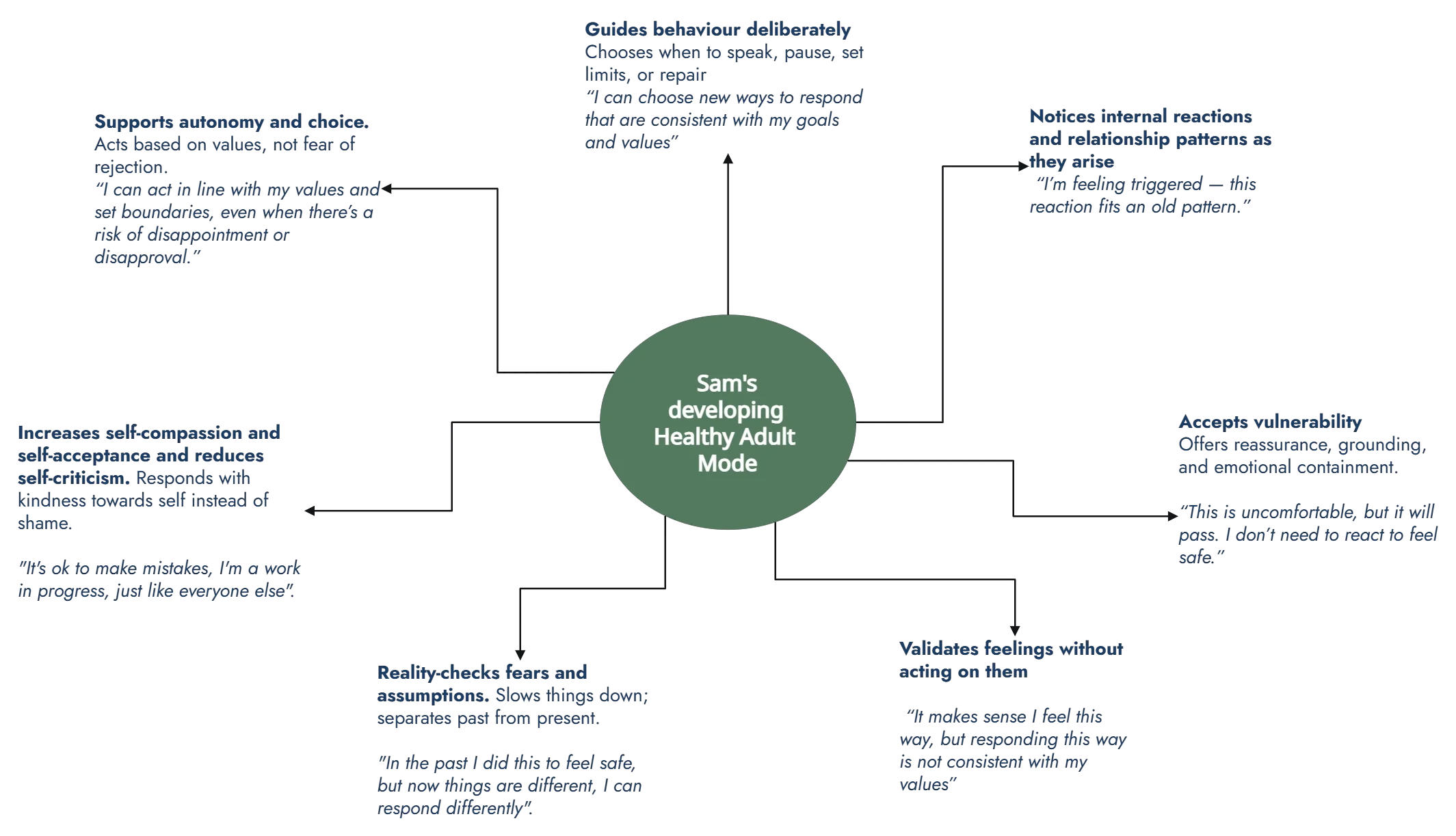
The primary goal — strengthening the healthy adult
The primary goal of Schema Therapy is to help Sam develop a strong and reliable Healthy Adult mode — the part of him that can notice what’s happening internally and in relationships, respond with understanding rather than automatic reactions, and make choices that reflect his values. As this mode becomes stronger, Sam is better able to soothe vulnerable feelings, regulate his emotions, set boundaries, reality-check fears, and reduce the influence of self-criticism or unhelpful coping patterns.
04
Schema Therapy may — or may not — be the right fit
IS THIS APPROACH A GOOD FIT?
A short guide to help you consider whether this kind of therapy is likely to be helpful at this stage.
Schema Therapy may be a good fit if:
✓
✓
✓
✓
✓
✓
✓
✓
You’re curious about how early relational or systemic experiences continue to shape your present life.
You’re looking for a deeper therapeutic process, and want to understand the needs and emotions that sit beneath your patterns of behaviour and relating.
You notice familiar emotional or relational patterns repeating — especially with the people you care about most — and you are ready to change.
You notice familiar emotional or relational patterns repeating—especially with the people you care about most, and you are ready to change.
You find yourself responding in ways that don’t always reflect your values, intentions, or sense of self.
You’re interested in understanding longstanding patterns, not just managing symptoms.
You’re interested in understanding longstanding patterns, not just managing symptoms
You’ve tried other therapeutic approaches and gained insight, but found it difficult to translate that understanding into lasting emotional or behavioural change.
—
—
—
—
—
Schema Therapy may not suit you if:
You’re currently experiencing psychosis or significant instability, and a period of stabilisation and support may be more helpful before engaging in this depth of work.
You’re not yet feeling ready to gently explore your own patterns of response and the impact on self and others, alongside developing compassion for the impact of past experiences on self.
You’re not currently interested in collaborative reflection on how both internal experiences and relational contexts shape your responses.
this is medium- to long-term work. The patterns are old, so shifting them takes time — it's not a quick fix. If you're after something shorter and more focused, another approach will likely suit you better.
As my work is offered online, there are limits to the support I can safely provide. If you’re experiencing active suicidal thoughts, I may only be able to work with you if you are also well supported by local services or trusted supports.
“Rather than focusing only on symptoms, Schema Therapy gives us techniques that facilitate deeper emotional processing — helping you make sense of past experiences, build healthier coping patterns, and move toward meaningful, lasting change.”
“
KYLIE WALLS · REGISTERED PSYCHOLOGIST
YOU MIGHT BE LOOKING FOR
Related areas of support
SERVICE
Trauma & Abuse Recovery
APPROACH
EMDR
APPROACH
Schema Therapy for Couples
I offer schema therapy for individuals and couples, providing an approach that addresses long-standing emotional and relationship patterns to support meaningful, lasting change.

Schema Therapy for individuals focuses on identifying and healing long-standing emotional patterns that shape how you see yourself, relate to others, and respond to stress. By addressing unmet emotional needs and the coping styles developed to manage them, this approach supports deeper insight, emotional regulation, and lasting change — particularly where difficulties have been present for a long time.

Schema Therapy for couples helps partners understand how their individual schemas and coping patterns interact within the relationship, often creating cycles of misunderstanding, conflict, or emotional disconnection. By increasing awareness, strengthening emotional safety, and supporting healthier ways of responding to one another, this approach can foster greater empathy, communication, and more secure connection over time.

Support is here when you are ready
LET’S GET STARTED
Reach out to request an initial appointment or send an enquiry via phone or message.